 Bin Drop Dumpster Rental
Contractor & Commercial Accounts Dayton
A contractor account skips the re-quoting on every project. Once the account is open, a Dayton remodeler or GC orders bins for a South Park kitchen gut one week and a Belmont roof tear-off the next, and the price per…
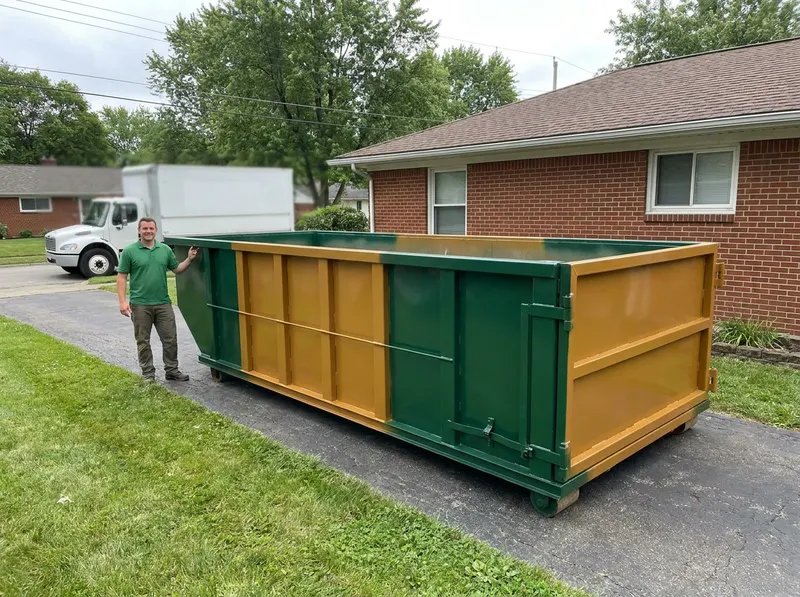
- What's included: a roll-off dumpster (10 to 40 yard), delivery, pickup, and disposal in one flat price, no per-ton surcharge.
- How fast: drops are typically scheduled next business day across Montgomery County; call by early afternoon for many same-week swaps.
- What it costs: flat rates of $595 (10-yard), $650 (15-yard), $695 (20-yard), $795 (30-yard), and $895 (40-yard), $595 minimum.
- What we take: construction debris, demolition waste, wood, drywall, roofing, and general jobsite trash, no liquids, tires, or hazardous material.
- How to book: call (937) 600-7780 to set up an account, then order bins per job by phone.
A contractor account skips the re-quoting on every project. Once the account is open, a Dayton remodeler or GC orders bins for a South Park kitchen gut one week and a Belmont roof tear-off the next, and the price per size never changes, 10-yard $595, 15-yard $650, 20-yard $695, 30-yard $795, 40-yard $895, flat and all-in. The number posted is the number invoiced, because tonnage and fuel are already baked into the rate.
Size the bin to the trade. A single-bath remodel in Grafton Hill fits a 10-yard, which holds roughly 4 pickup-truck loads. A full kitchen or a two-room flip in St. Anne's Hill runs better with a 20-yard at about 8 loads. Roofing crews stripping shingles across Five Oaks or Dayton View lean on the 30-yard because asphalt is heavy and dense, the flat price means a heavy roofing load costs the same $795 whether the bin comes back at 3 tons or 5. A framing or full demo job in Kettering (Old North Dayton) or Walnut Hills usually calls for the 40-yard at $895 for high-volume, lighter debris like lumber and drywall. The trade-off is driveway and jobsite footprint versus how many hauls you want to pay for: a bigger bin costs more up front but means fewer swaps and less downtime.
Delivery works on a simple sequence. First, the account is set up over the phone with a name and billing contact. Second, each job is ordered by size and address, most Dayton drops are scheduled for the next business day. Third, the driver sets the roll-off on plywood or boards to protect the surface. Fourth, a call brings the swap or final pickup, and the bin is hauled to a licensed Montgomery County transfer site.
A contractor account is not junk removal, the crew loads the bin, and the container stays on site for the rental term rather than a same-hour haul-off. For jobs near the Oregon District or McPherson Town, where narrow historic streets and on-street parking are tight, the smaller 10- and 15-yard bins fit driveways and alleys where a 40-yard cannot maneuver. Placing a dumpster on a public street in the City of Dayton can require a permit; the property owner or contractor is responsible for arranging that with the city before the drop. Prohibited items, wet paint, tires, appliances with refrigerant, and hazardous chemicals, are excluded from every size and must go to their proper facility.
Contractor & Commercial Accounts cost in Dayton
Every job gets a firm, written price after a free on-site visit.
Common questions
Do contractor accounts in Dayton get a lower rate than a one-time rental?
How fast can dumpsters reach a jobsite in Dayton?
Which dumpster size fits a roofing tear-off in Dayton?
Do I need a permit to place a dumpster on a Dayton street?
What can't go in a contractor dumpster in Dayton?
Get started today
Tell us about your contractor & commercial accounts job in Dayton and we'll send a clear, written quote, usually the same day.